Showing posts with label Articles by Artists. Show all posts

Artful Inspiration

Artful inspiration, studio notes and interesting blog bits 
from artists that may inspire your creative muse!


"A Gentle Breeze" by Kimberly Kelly Santini

Working thru the Uglies

Have you ever had a painting that sunk deep into "The Uglies" ... that stage where the artist is still working things out, and nothing quite yet meshes or works visually?    Reading this blog post from Kimberly Kelly Santini (Painting a Dog a Day) as she

Worst Mistake Acrylic Painters Make


Michele Theberge

Do you know how much water is OK to add to your acrylics? Ever heard of the term "underbinding". Michele explains what the art conservators know, but most artists have never been taught -- how much water can be added to the paint without destabilizing the paint film.

How To Paint a Red Tree


Artist and author Karen Margulis offers tips for painting brilliant Fall foliage and avoiding dull and washed out colors.  Karen is a pastel artist but these color tips apply to all mediums.

Telling a Story with Your Paintings


Artist and instructor Richard Robinson shares some tips for adding more interest to your paintings.


Valuable Advice from Steve Fleming

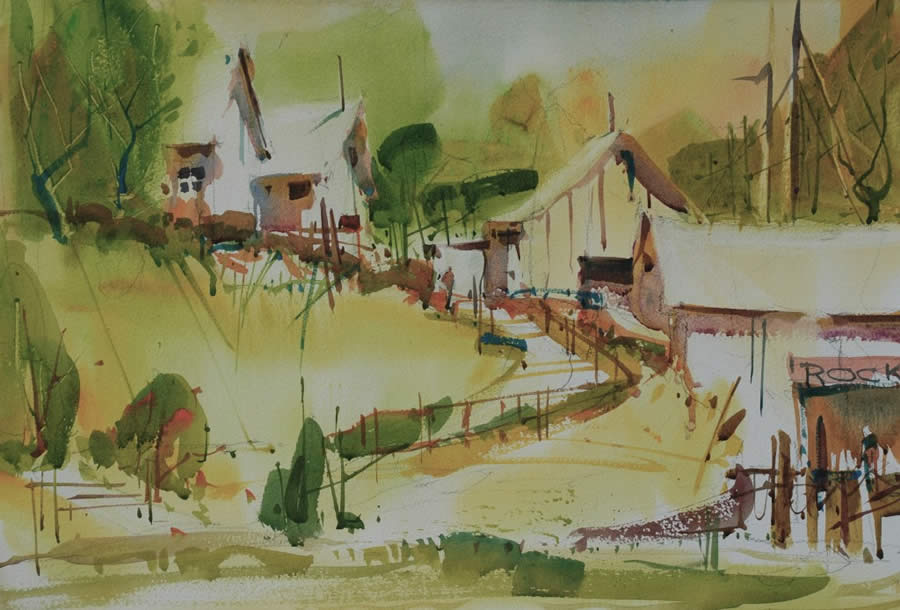
“Rockport Village” 18 x 24 Watercolor, Steve Fleming

In his article, Steve Fleming writes: "When painting it is easy to become so involved in the subject matter with all of the details, textures, and colors presenting so many possibilities that our paintings never quite have focus or a feeling of unity. Sometimes we achieve nothing more than to present to the viewer either a collection of random thoughts about a place or detail laden color drawing. We paint around the subject never quite making a point."   

He continues on to give us some very valuable advice for achieving focus in our paintings using a strong value plan and focal point. Whether you paint with oils, acrylics or watercolors, whether your landscapes are painted with precise detail or expressive loose brushstrokes, if you follow the suggestions outlined in this article you should experience some dramatic improvements and increased satisfaction with your artwork!

A Creative Spirit Set Free

Spring Low Tide, Acrylic, Marcia Burtt
Marcia Burtt explains how the medium of acrylics can remove limitations and expand an artist’s options for creative expression.
"Marcia Burtt refuses to be hemmed in. She wants her freedom—to paint outside when the weather is right, to paint the way she wants to paint, and to change her mind as often as she pleases.  And since discovering a medium that lets her do all this and more, she’s been breaking through limitations that once thwarted her."  

Article: What Shall I Paint?

Watercolor by Ray Campbell-Smith
A new article has been added to our "Inspiration" section titled "What Shall I Paint?".   From inspiration to composition and several steps in between, Professional Artist Ray Campbell-Smith discusses the importance of being selective when composing a painting.

Ray Campbell-Smith is author of Landscapes in Watercolour (Step-by-Step)
and The Artist's Handbook plus many more art instruction books.

Poured Watercolor with Stephen Blackburn

Watercolor by Stephen Blackburn
Stephen Blackburn has received international recognition for his watercolor paintings.  He concentrates on close-focus subjects such as florals and still lifes.   The artist says that "pouring pigments is a great way to keep colors pure, although it does take some planning to achieve the right effect."   Blackburn explains his technique for poured watercolors in this article titled "Liquid Watercolors",  reprinted from "The Artists" magazine (in PDF format).

Article: The Order of Attraction


A successful painting is not simply a well designed depiction of a pleasant subject any more than a successful novel is a grammatically correct description of an interesting event. Good art requires more than that. The artist must convey his personal response to the subject and direct attention to the important elements.

One way to do this in painting is by planning the placement and degree of contrast. This would be much easier if the three kinds of color contrast—value, intensity, and hue—were equally attractive to the eye. But they’re not.  Read more about value, intensity and hue in this PDF.

We get better at painting by painting

Blossoms Reflecting, Kent Wallis

The following commentary is from well-known artist Kent R. Wallis......

The pseudo-intellectual community will have us analyzing art for analysis sake; viewing art for viewing sake; buying art for buying sake. They will tell us white is black, good is bad, ugly is beautiful. All this will be done in an effort to convince the ordinary person that he or she cannot understand nor appreciate art. They endeavor to

Hints and Tips for Painting Skies

Painting clouds with acrylics

In this article by artist Rosemary Hale, she offers many tips and hints for painting skies and realistic clouds using acrylic paints.   Hale writes:  "... a sky’s mood and atmosphere will influence the colours and tones of the landscape below, and this should be taken into account when planning a picture......It is important to give a sky the vaporous, atmospheric character that clouds possess and it is the edge of a cloud that most puts this across. An unbroken hard edge against the sky colour will look like a cartoon, whereas a soft edged cloud immediately becomes more vaporous and believable."

Inspiration

"Chimayo Church" watercolor by Russell Black
Don't forget to check our "Inspiration" page for articles written by artists on topics such as: Being Creative, Working thru the Uglies and Challenging Yourself.
Related Posts Plugin for WordPress, Blogger...