 |
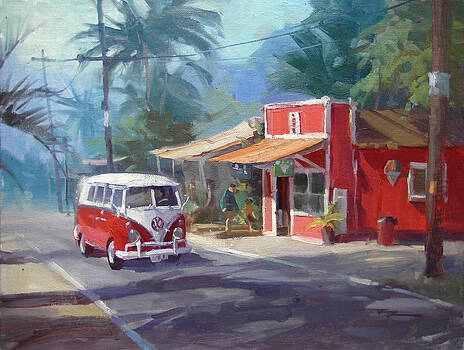
| Haleiwa by Richard Robinson |

Showing posts with label Composition. Show all posts
Showing posts with label Composition. Show all posts
Telling a Story
Labels:
Composition,
Richard Robinson,
Studio Notes,
video-demo


Telling a Story with Your Paintings

Artist and instructor Richard Robinson shares some tips for adding more interest to your paintings.
Labels:
Articles by Artists,
Composition,
Richard Robinson
Watercolor Demo by Paul Talbot-Greaves

This watercolor painting of the old Pennine Inn by professional artist and tutor Paul Talbot-Greaves is a good example of how to create drama and depth in a painting. He also makes great use of the stone wall as a lead-in to the center of interest. This painting took around two hours to complete. It was done on Saunders Waterford 300lb rough paper. Time-lapse video demo below.
Paint Lake with Distant Cliffs
 |
| "Quiet Morning: Ramah Lake" by M.C.Johnson |
In this step-by-step tutorial, pastel artist Michael Chesley Johnson describes his methods for painting with a local color underpainting. Johnson says: "I want a quiet, very harmonious finished piece, so I try three values of a cool, purple-violet for the underpainting and layer cool "local" colors on top of this, saving my warm touches for the red cliffs." Johnson gives us valuable advice about using a limited palette and sticking with a value plan. He says: "I mark my lightest and darkest areas. This shows me at a glance the range of values I must stick with in the painting. No color will be lighter or darker than these."

by Michael Chesley Johnson and Ann Templeton
The Art of Ann Templeton explores the world and work of Ann Templeton. With over 120 full-color plates, the book illustrates her use of materials and techniques, her travels, and her approach to workshops, as well as her take on what it is to live the life of an artist. Primarily a plein air painter, Ann Templeton has developed techniques over 30 years of painting to capture the landscape quickly and to interpret it with her unique vision of color and design.
Article: What Shall I Paint?
 |
| Watercolor by Ray Campbell-Smith |
A new article has been added to our "Inspiration" section titled "What Shall I Paint?". From inspiration to composition and several steps in between, Professional Artist Ray Campbell-Smith discusses the importance of being selective when composing a painting.
Ray Campbell-Smith is author of Landscapes in Watercolour (Step-by-Step)
and The Artist's Handbook plus many more art instruction books.
Labels:
Articles by Artists,
Composition,
Ray Campbell-Smith
Article: The Order of Attraction

A successful painting is not simply a well designed depiction of a pleasant subject any more than a successful novel is a grammatically correct description of an interesting event. Good art requires more than that. The artist must convey his personal response to the subject and direct attention to the important elements.
One way to do this in painting is by planning the placement and degree of contrast. This would be much easier if the three kinds of color contrast—value, intensity, and hue—were equally attractive to the eye. But they’re not. Read more about value, intensity and hue in this PDF.
Labels:
Articles by Artists,
Color Theory,
Composition
How to Draw a Building in Perspective

Using 2-point perspective, learn how to draw a house, including roof with overhanging eaves, with this tutorial from artist and author William Powell. This lesson is an excerpt from his book "Perspective
 ".
".
Labels:
Buildings-Structures,
Composition,
Drawing
Painting Flowers Step by Step: Pansy Power
 |
| Little Pansy, 10x15 watercolor by Birgit O'Connor |
Birgit O'Connor teaches workshops in her studio in Bolinas, California and has published instructional books including Watercolor in Motion: How to Create Powerful Paintings, Step by Step
 and Watercolor Essentials: Techniques for Exploring, Painting and Having Fun
 , both available at Amazon.com.
Labels:
Birgit O'Connor,
Composition,
Florals,
Watercolor
Basics of Landscape Composition

Labels:
Composition,
Landscape,
LDiane Johnson,
Studio Notes
Landscape Composition Rules

Johannes Vloothuis has compiled 40 landscape composition rules for artists with samples and corrections. He says: "I have put together a series of 'rules'... of composition that when used properly should reduce the flaws in your landscape paintings. ....They are to help you out when you are in doubt on where to place diverse elements in your work. "
Labels:
Composition,
Johannes Vloothuis,
Landscape
Forest Entry, G.A. Durkee

In this excerpt from his book "Expressive Oil Painting", George Allen Durkee demonstrates each step in this painting while talking about composition and other elements of a painting.
Labels:
Composition,
George Allen Durkee,
Landscape,
Oil Painting,
trees
Secrets of Oil Painting, Andre Grobler

Labels:
Andre Grobler,
Color Theory,
color wheel,
Composition,
Oil Painting,
Studio Notes
Subscribe to:
Posts (Atom)
